


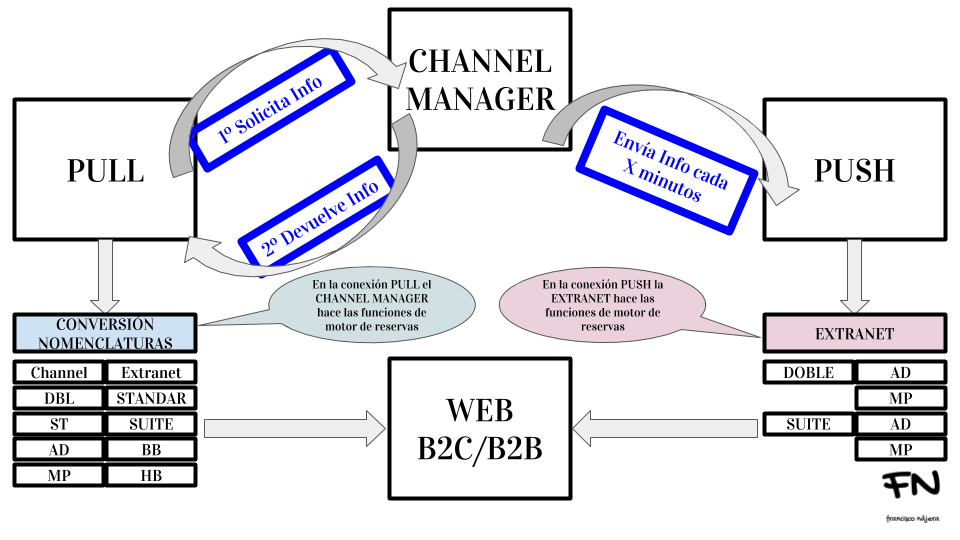
What do pull and push mean in hotel distribution?
Pull and push are two ways for a hotel and its distribution channels to exchange availability, rates and restrictions. They often come up in technical conversations with distributors and providers, but the difference is simple: it depends on who requests the information and who sends it. Both models usually rely on a channel manager, the tool a hotel uses to manage inventory, prices, minimum stays, closures and other conditions across different channels.
Pull connection: the channel requests the information
With a pull connection, the channel queries the hotel system whenever it needs availability and sales conditions. The channel manager returns the requested information and effectively acts as the source of inventory and rates.
Advantages of a pull connection
- The query can use information that is up to date at the time it is made.
- Rate, availability or restriction changes can be reflected quickly.
- The process usually requires fewer bulk data transmissions.
- When the integration is well designed, it can reduce certain synchronisation problems.
What to check
A pull connection still needs to be configured correctly. Check that room codes, meal plans, occupancies, rates and policies used by both systems are mapped correctly. If the hotel calls a room “DBL” and the channel uses a different code, the two must be linked properly. Also verify which information the integration actually supports. Not all channels process the same restrictions, supplements or policies.
Push connection: the hotel sends updates
With a push connection, the channel manager periodically sends availability, rates and restrictions to the channel. The distributor receives and stores these updates for use in its own sales environment.
Advantages of a push connection
- Changes can be distributed to multiple channels from one central platform.
- There is less need to update each extranet manually.
- It makes it easier to manage inventory, rates and restrictions at the same time.
- It is a widely used model and is compatible with many distributors.
Risks and controls
Updates may depend on how often data is sent and processed. If there is a delay or connection error, a sales closure or rate change may not appear immediately. A channel can also sell only the rooms, occupancies and meal plans that have been created and mapped correctly. Some conditions—such as supplements, commissions or certain policies—may need to be configured manually in the extranet.
Pull vs. push: the main differences
- Pull: the channel requests the information when it needs it.
- Push: the hotel system sends updates to the channel.
- Both: mapping, monitoring and data quality remain essential.
There is no universally better model. The right choice depends on the channel’s technology, the channel manager’s capabilities, inventory volume and the level of control the hotel needs.
Common errors with either connection
- Rooms or meal plans mapped incorrectly.
- Occupancies that exist in the PMS but not in the channel.
- Adult or child supplements that have not been configured.
- Inconsistent cancellation policies.
- Commissions or discounts applied twice.
- Restrictions that the channel does not support or interprets differently.
- No review after a technical change.
After activating a connection, make test bookings, check the flow into the PMS and review how rates, taxes, policies and occupancies appear on the channel.
Pull, push and revenue management strategy
Connectivity is not just a technical issue. Poor configuration can affect rate parity, cause overbookings, delay pricing decisions or leave inventory undistributed. That is why technology should be reviewed as part of a hotel’s revenue management and commercial strategy. If you need to review your channel setup, improve distribution or align technology with strategy, I can help through hotel revenue management or hotel consultancy tailored to your property or portfolio.